

LSEG / Refinitiv
Financial Intelligence Mobile App
Senior UX Designer
Led hands-on UX design for new features and workflows in a data-dense financial intelligence mobile application used by professional investors and analysts.
Impact:
Reduced time-to-insight by ~20–30% in core user tasks
Improved feature adoption by clarifying data hierarchy and interaction patterns
Contributed patterns and components to a shared design system used across multiple teams
My Role & Scope
I worked as a Senior UX Designer, contributing hands-on across discovery, interaction design, prototyping, and delivery. I partnered closely with product managers and engineers, and collaborated with adjacent teams to ensure consistency across the mobile experience.
Key constraints
Regulated financial environment
Data-dense, time-sensitive workflows
Mobile-first constraints
Existing patterns and legacy decisions
The Problem
Professional users rely on the app to extract actionable insights quickly from complex financial data. However, existing interfaces surfaced too much information at once, increasing cognitive load and slowing decision-making — particularly in time-sensitive scenarios.
The challenge was to improve clarity and speed without reducing data depth, while operating within regulatory, technical, and design system constraints.
Key UX Metric
For this work, success was measured by time-to-insight, how quickly users could locate, interpret, and act on relevant financial information.
Design decisions focused on reducing visual noise, clarifying hierarchy, and surfacing primary signals earlier in the workflow.

Design Decision 1:
Progressive Disclosure
Early explorations exposed too much data simultaneously, which slowed comprehension. I explored alternative hierarchy models and applied progressive disclosure to reveal secondary information only when needed.
This preserved analytical depth while allowing users to reach key insights faster.

Design Decision 2
Complement, Not Replicate
Early in the project, it became clear that mobile screen sizes could not comfortably accommodate the same volume and density of information as the desktop experience.
Mobile experience was intentionally designed to complement the desktop rather than compete with it.
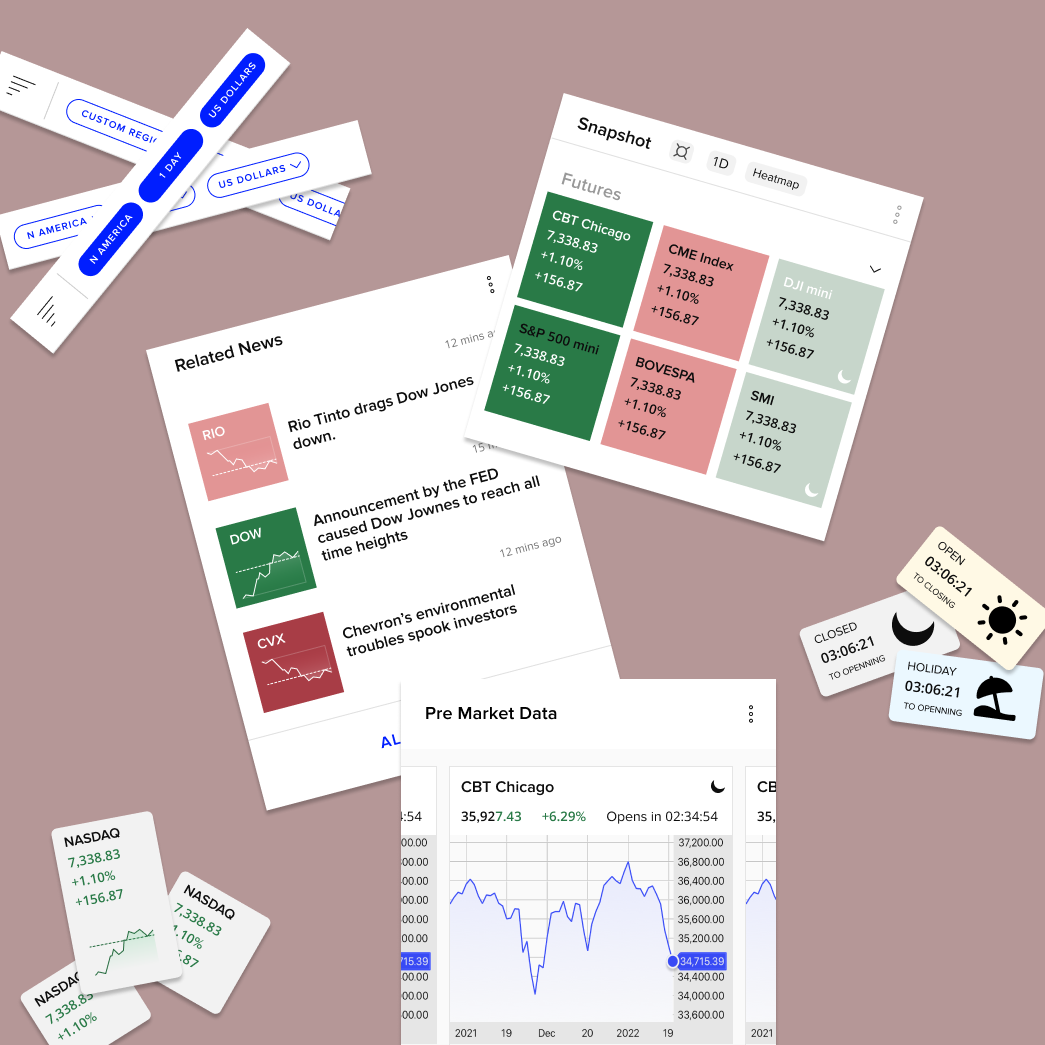
Design Decision 3
Designing for “On-the-Move”
Based on the research, the mobile experience was optimized for glanceable, context-relevant data, surfacing the most time-sensitive information upfront and deferring detailed exploration to secondary interactions or desktop workflows. It helped users to stay informed quickly and efficiently in short sessions.

Design System Contribution
I contributed patterns and components back into the shared design system, improving consistency across features and reducing duplicated design effort across teams. This helped new functionality ship faster while maintaining a coherent experience.
Outcome
The delivered work improved clarity and efficiency in a complex, regulated financial product, helping professional users extract insights faster and make more confident decisions under time pressure.
The project reinforced the importance of clear hierarchy and progressive disclosure when designing data-dense mobile experiences at scale. It contributed to an estimated ~20–30% reduction in time-to-insight during internal testing and feedback.
30%
Disclaimer
This case study is based on professional work at LSEG / Refinitiv. All visuals are simplified and do not include confidential or proprietary information.